Tag: washington post
Legacy News Outlets That Bent Knee To Trump Losing Their Credibility -- And Audience

Legacy News Outlets That Bent Knee To Trump Losing Their Credibility -- And Audience

It turns out that there isn’t a ratings bump for MAGA capitulation.

David Ellison, the son of President Donald Trump’s megabillionaire ally Larry Ellison, took control of CBS last year following a corrupt deal that saw its parent company settle a lawsuit with the president and agree to implement a new conservative ombudsman for CBS News. As part of that takeover, he also installed conservative journalist Bari Weiss at the helm, promising that her “entrepreneurial drive and editorial vision” would “invigorate” the network. But six months into Weiss’ rightward makeover of CBS, the fruits of her labors include cheers from Trump and Defense Secretary Pete Hegseth for making the network more palatable to their aims, complaints from the CBS newsroom that she is dismantling its independence — and, it now appears, a viewer exodus.

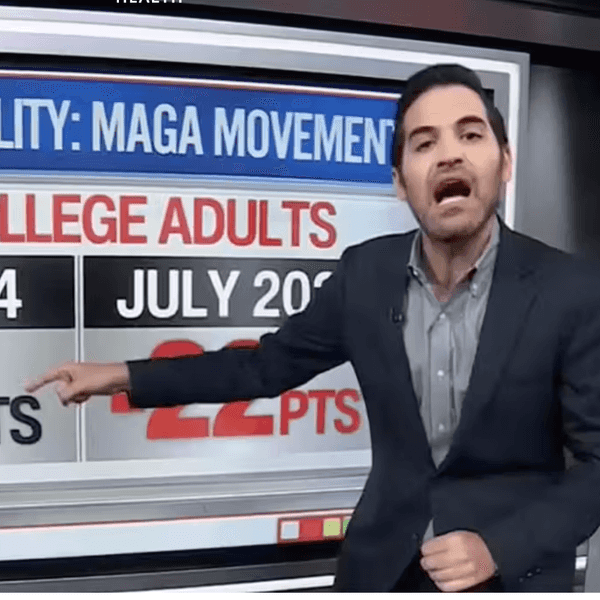
Status’ Oliver Darcy got ahold of some CBS News ratings data from the first quarter of 2026, and it is brutal. CBS Evening News has lost seven percent of viewers year-over-year, placing it “on track for its lowest-rated first quarter of the 21st century in both total viewers and the advertiser-coveted 25-54 demographic,” while CBS Mornings plummeted 13 percent and “is pacing toward its lowest-rated quarter on record in both total audience and the key demo.” Meanwhile, the audiences of competitor shows at ABC News and NBC News grew over the same period.

The ratings collapse is a devastating indictment of the strategy Ellison and Weiss are executing at CBS — and a blaring warning for CNN if Ellison is able to complete his takeover of that network and let Weiss run the same playbook there.

Meanwhile, new data from the Alliance for Audited Media show that while average daily print circulation among major audited newspapers saw year-over-year declines across the board in the six months running through the end of September 2025, the biggest drops came at The Washington Post, which fell 21.2 percent followed by the Los Angeles Times, down 19.8 percent. Their billionaire owners — Amazon founder Jeff Bezos and biotech mogul Patrick Soon-Shiong, respectively — had responded to Trump’s return to the White House by trying to shift their papers to the right.

None of this should come as a surprise

Ellison and Weiss have suggested that the core problem for American media is that the public does not trust news outlets, and that the reason for this is that the public perceives those outlets as too far left and too critical of the right. They propose to win over a larger audience by deliberately course-correcting in the opposite direction.

“We are not producing a product that enough people want,” Weiss said at a CBS News staff town hall in January. Weiss attributed this to two factors. “First: Not enough people trust us. Not you. Us. As in: the mainstream media,” she said. “Second: We are not doing enough to meet audiences where they are. So they are leaving us.”

Weiss is correct that trust in traditional media has fallen dramatically in recent decades, particularly among conservatives — indeed, this is a banal truth that everyone remotely connected to the media knows. But her strategy of conceding that potential viewers are correct to distrust journalists and seeking to “meet audiences where they are” by signaling that coverage will now be deliberately shifted to the right has had the obvious result of driving away the existing audience without adding a new one.

CBS News’ viewers either liked what they were already watching or they liked what watching Edward R. Murrow’s old network said about them. When the network’s new ownership and management proposed taking its programming in a dramatically different direction in search of a different audience — as the wildly unpopular president cheered — the existing viewers could see that, and some decided that CBS is no longer worth their patronage.

Weiss’ theory of the case is that these losses could be made up by new viewers with more right-leaning views. But the decline in public trust for traditional media among Republicans stems at least in part from a decades-long strategy pursued deliberately by the GOP and conservative movement. That effort revolves around simultaneously denouncing news outlets as liberal propaganda while encouraging conservatives to instead patronize new, deliberately right-wing news sources. And it’s been taken to another level under Trump, who relentlessly attacks the press while using state power to reduce its influence and lift up the MAGA media operation.

That dynamic makes it wildly implausible that the shift Weiss enacted would win over a sizable new segment of viewers. Her version of CBS may garner praise from Trump, but people who might be swayed by his comments already have — and are likely already patronizing — a plethora of pro-Trump outlets. You could imagine a scenario where some slightly more right-wing viewers of the ABC and NBC news shows switched to watching the new CBS. But instead, the data Darcy cited suggests, CBS appears to be shedding viewers who are instead watching its competitors — or exiting broadcast television altogether as their news source.

As for Bezos’ Post and Soon-Shiong’s Times, when the owners similarly bet on trying to make their outlets more acceptable to Trump, their existing audiences looked for the exits and were not replaced. The efforts may win over the likes of Tucker Carlson or even the president himself, but MAGA isn’t rushing to buy subscriptions.

For Ellison, Bezos, and Soon-Shiong, the declines in their news outlets may be a small price to pay to win over Trump. Each owner has massive business holdings outside of the press and can afford the losses from tearing down their news outlets if it wins the Trump administration’s support for their desired mergers, contracts, or patents.

The journalists facing layoffs from their outlets — and the public who lose access to their reporting — are the ones who will actually suffer from this doomed strategy.

Reprinted with permission from Media Matters
At 'Washington Post,' Bezos' Bozos Struggle To Justify High Drug Prices

At 'Washington Post,' Bezos' Bozos Struggle To Justify High Drug Prices

I am tempted just to ignore the Washington Trump-Post after Jeff Bezos’ purge, but perhaps there is some ridicule value that can be exploited for the purpose of educating the public. The Post ran an editorial complaining that people looking to lower drug prices in the United States were being short-sighted because it just means that we will see fewer new drugs in the future. It said the real problem is that Europe doesn’t pay enough for drugs because they don’t give drug companies unfettered government-granted patent monopolies, but instead limit prices based on a drug’s usefulness.

Two simple numbers show how ridiculous the Post’s argument is. Last year we spent over $720 billion on drugs and other pharmaceutical products. The industry spent around $150 billion on research. That means patients in the United States paid almost five times as much for drugs as what the industry spent on research.

It likely costs around $150 billion to manufacture and distribute the drugs. (We know this based on the price that generic drugs sell for.) That leaves the industry with $570 billion to cover $150 billion in research. The rest goes to profits, advertising, high pay for CEOs and other top executives, and payoffs to politicians, doctors, and media outlets.

Fans of arithmetic, which I guess excludes the Washington Post editors and other Trumpers, would know that Europe would be paying plenty to cover research costs, even if its prices were 40 percent of U.S. prices. The only thing that would be accomplished by raising the price of drugs in Europe is that Jeff Bezos’ rich friends would become even richer.

If we want to talk seriously about lowering drug prices, we would be looking to change the way we support research. Instead of relying on government-granted patent monopolies, we could just pay for the research upfront, say by vastly increasing the $50 billion we now spend funding research through the National Institutes of Health. Then all the research could be fully open source, with all patents in the public domain.

Not only would this mean that new drugs could be sold as cheap generics from the day they are approved by the FDA, but research would likely advance more quickly since new findings would quickly be made freely available. This would allow researchers all over the world to follow promising leads and avoid proven dead ends.

This way of financing research would also remove the enormous incentive the industry now has to lie about the safety and effectiveness of new drugs. We saw this problem most clearly with the opioid crisis where the industry misled doctors about the addictiveness of the new generation of opioid drugs, but the issue of misrepresenting research comes up all the time. It is exactly what economic theory predicts happens when a government monopoly allows companies to sell products at prices that are thousands of percent above production costs.

I have been screaming about the corruption of the pharmaceutical industry for a long time and pushing direct upfront funding as an alternative. I am happy to see a new paper from Dana Brown at the Vanderbilt Policy Accelerator making the same argument.

There’s an old saying that intellectuals have a hard time dealing with new ideas, and direct upfront funding of pharmaceutical research is certainly a new idea to people who can’t imagine an alternative to patent monopolies. Also, since the major media outlets are controlled by rich people like Jeff Bezos, they aren’t anxious to publicize policies that could cost their rich friends hundreds of billions of dollars.

But at least folks who read my stuff can know. The Washington Post is lying to you. There are more efficient mechanisms to finance biomedical research which can give us both lower drug prices and better medicine. Drugs can and should be cheap, we don’t have to make them expensive with patent monopolies. Maybe one day we will be able to have a serious discussion about alternatives to patents to finance the development of new drugs.

No, The Times Didn't 'Debunk' Post Report On Alleged War Crime In Missile Strike

No, The Times Didn't 'Debunk' Post Report On Alleged War Crime In Missile Strike

Right-wing commentators have seized upon a New York Times report on the U.S. military’s September 2 extrajudicial killing of 11 people on board a boat the Trump administration alleged was carrying drugs in the Caribbean, claiming that the article “DEBUNKED” a previous Washington Post report that triggered congressional scrutiny over potential war crimes. But the Times actually confirmed, rather than undermined, the Post’s account.

The Post reported Friday that according to its sources, Defense Secretary Pete Hegseth gave a spoken order “to kill everybody” on board the boat before the attack, and that after confirming that the first strike left two survivors, the Navy special operations commander overseeing the action, Adm. Frank Bradley, “ordered a second strike to comply with Hegseth’s instructions,” killing them. Lawmakers of both parties quickly vowed to aggressively scrutinize the attack, which legal experts argued would constitute, “at best, a war crime under federal law.”

Hegseth, in his prior career as co-host of Fox News’ Fox & Friends Weekend, championed U.S. service members accused or convicted of war crimes. In one 2019 segment discussing a soldier charged over the extrajudicial killing of an Afghan man accused of making bombs for the Taliban, Hegseth said, “If he committed premeditated murder … then I did as well. What do you think you do in war?”

Top Trump administration officials over the weekend denounced the “fake news” Post’s “entire narrative” as “fabricated” with “NO FACTS.” But at Monday’s briefing, White House press secretary Karoline Leavitt effectively confirmed — and defended — the actions the Post had reported, including the second strike.

This confusion left President Donald Trump’s most zealous propagandists with few clear pathways to defend the administration’s actions. But after the Times published its own account of the attack on Monday, “plenty of conservatives are now declaring this case closed,” as Politico reported. Indeed, right-wing commentators have claimed that the Times “quietly DEBUNKED” the Post’s “hoax hit piece,” which they said has been exposed as “a genuinely vile slander of both Hegseth and Bradley.”

“Disgrace to journalism that [Post reporters] @AlexHortonTX and @nakashimae got so many details of this story wrong just to smear @PeteHegseth,” posted RedState's R.C. Maxwell, a member of the new Pentagon press corps composed of MAGA shills.

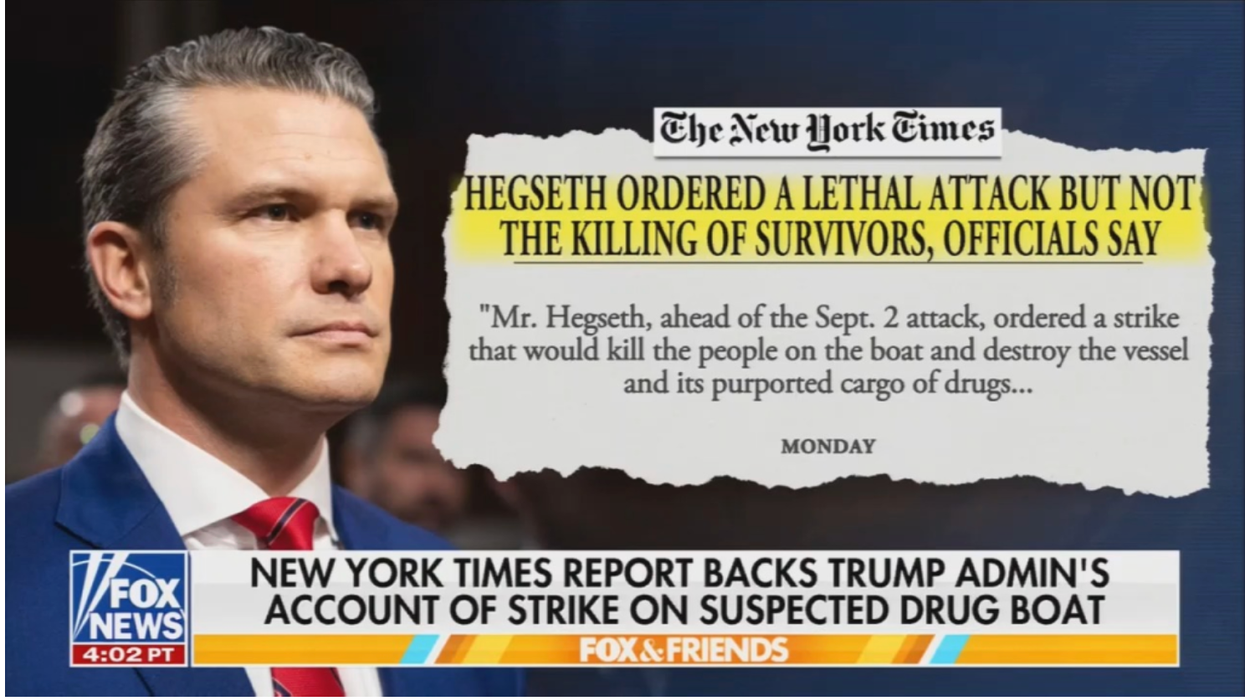
Fox News, Hegseth’s former employer, had devoted 53 minutes of airtime to the story across the four days from Friday through Monday. The bulk of that coverage came from purported “news side” shows; Jesse Watters was the only prime-time host to address the story, while the defense secretary’s old program ignored it altogether. Coverage picked up on Tuesday morning, however: Apparently armed with new marching orders at last, Fox & Friends finally found an angle and reported on how the “New York Times report backs Trump admin’s account of strike on suspected drug boat.”

In reality, the timeline of the September 2 attack laid out in the Times article matches the one provided by the Post.

First, after U.S. intelligence operatives determined that the boat was carrying drugs, Hegseth issued his order to destroy it and kill those onboard.

From The Washington Post:

The longer the U.S. surveillance aircraft followed the boat, the more confident intelligence analysts watching from command centers became that the 11 people on board were ferrying drugs.
Defense Secretary Pete Hegseth gave a spoken directive, according to two people with direct knowledge of the operation. “The order was to kill everybody,” one of them said.

From The New York Times:

According to five U.S. officials, who spoke separately and on the condition of anonymity to discuss a sensitive matter that is under investigation, Mr. Hegseth, ahead of the Sept. 2 attack, ordered a strike that would kill the people on the boat and destroy the vessel and its purported cargo of drugs.
...

In interviews on Monday, two U.S. officials — both of whom were supportive of the administration’s boat strikes — described a meeting before the attack at which Mr. Hegseth had briefed Special Operations Forces commanders on his execute order to engage the boat with lethal force.

Then, the Navy launched an initial strike, which left two survivors, who were killed after Bradley ordered further strikes.

From The Washington Post:

A missile screamed off the Trinidad coast, striking the vessel and igniting a blaze from bow to stern. For minutes, commanders watched the boat burning on a live drone feed. As the smoke cleared, they got a jolt: Two survivors were clinging to the smoldering wreck.
The Special Operations commander overseeing the Sept. 2 attack — the opening salvo in the Trump administration’s war on suspected drug traffickers in the Western Hemisphere — ordered a second strike to comply with Hegseth’s instructions, two people familiar with the matter said. The two men were blown apart in the water.

From The New York Times:

Admiral Bradley ordered the initial missile strike and then several follow-up strikes that killed the initial survivors and sank the disabled boat.

The Times account stresses that Hegseth’s “order was not a response to surveillance footage showing that at least two people on the boat survived the first blast,” and that the defense secretary “did not give any further orders” to Bradley following the first strike — but the Post’s account does not say otherwise.

It is unclear whether the Post’s reporting that Hegseth issued a “spoken directive” to kill those onboard the boat is describing something different from the Times’ reporting that Hegseth briefed commanders on his order to “engage the boat with lethal force.” But both agree that Bradley ordered a second U.S. strike which killed shipwrecked survivors.

That second strike, experts say, constitutes “at best” a textbook war crime (if you accept the administration’s dubious claims that this constitutes a lawful conflict in the first place; otherwise, both strikes are simply murder). Trump said Sunday he “wouldn’t have wanted … a second strike,” though Leavitt defended Bradley ordering one on Monday.

The right-wing complaints amount to hair-splitting over the exact extent of MAGA favorite Hegseth’s responsibility for the allegedly unlawful killings — and it's based on two reports that paint a consistent picture. Did Hegseth cause the second strike with his initial order, or did he merely watch Bradley order it in real time with no apparent qualms about it, then promote Bradley, give a speech urging military leaders to “untie the hands of our warfighters” to ensure “maximum lethality,” and then defend the attack and mock its critics?

Either way, the Times article doesn't vindicate him.

Reprinted with permission from Media Matters
The Media's Rich Owners Want Generations To Fight Each Other -- Not Classes

The Media's Rich Owners Want Generations To Fight Each Other -- Not Classes

The idea of generational warfare is pernicious tripe. It gets pushed endlessly in the media because rich people would rather see kids lashing out at their parents than at them. And since the rich own the media, we hear a lot about generational inequality. Jeff Bezos’ Washington Post gave us the latest effort at generational warmongering.

Just to give some basic facts that are not in dispute, the country is getting richer year by year. Using the projections from the Social Security Trustees, per capital income is projected to be 15.4 percent higher in 2035, 32.6 percent higher in 2045, and 54.3 percent higher in 2055, when virtually all the baby boomers will be dead.

Since the baby boomers are for the most part not going to be partaking in these higher levels of consumption, who do the generational warriors think will be getting this income? It’s worth mentioning that these could prove to be very conservative projections of income growth. If AI has anywhere near the impact its proponents are claiming, per capita income will grow by far more than the Social Security trustees are projecting.

Given the indisputable fact that the country is getting richer, how can there be a story where Gen Xers, Millennials, and Gen Zers will be poorer on average than baby boomers? There is a story where generations can do worse through time, but that would be a story of within-generation inequality, not between-generations inequality.

The problem is not greedy boomers, but rather ridiculously rich people like Elon Musk, Jeff Bezos, and Mark Zuckerberg hoarding the country’s wealth for their own use and the use of their heirs. People are less likely to see that story because these super-rich people are the ones who own the major media outlets and social media platforms, but that is reality.

Given these simple and undeniable facts, it is striking how often we see this generational inequality nonsense. As is the case with this Post piece, they often push outright lies to make their case. For example, this piece tells readers:

“’Baby boomers “entered the labor force during decades of strong economic growth, rising productivity and relatively high real wages,’ Mitchell said. They were in their prime earning and saving years during long bull markets, namely in the 1980s and ’90s, she said, as well as the economic recovery that followed the Great Recession.” ….

“And ‘particularly for middle-income workers, real wage gains since the 2000s have been modest, compared to the robust wage growth that boomers benefited from mid-career,’ Mitchell said.” [Prof. Olivia Mitchell, who teaches business economics and public policy at the University of Pennsylvania’s Wharton School.]

“Post-World War II, ‘you had this tremendous boom that many got to ride for a very long period of time,’ Ney said.” [Jeremy Ney, a professor at Columbia University’s business school.]

This turns reality on its head. As I wrote in a piece last month:

“There was in fact a golden age, but it predated the entry of most boomers into the labor market. The economy experienced a period of low unemployment and rapid real wage growth, which was widely shared, from 1947 to 1973. At the endpoint of this boom period, the oldest boomers were 27, and the youngest were 9.

“After 1973, the economy took a sharp turn for the worst. The most immediate cause was the Arab oil embargo, which sent oil prices soaring. The economy at that time was far more dependent on oil than is the case today. Soaring oil prices sent inflation higher, which prompted the Fed to bring on severe recessions, first in 74-75 and then again in 1980-82.

“The full story is more complicated and highly contested, but what happened to the economy is not. We had a period of far higher unemployment and stagnant real wage growth that lasted until the mid-1990s. The median real wage in 1996 was actually 4.4 percent lower than it had been in 1973.

“The average unemployment rate for people between the ages of 20-24 over the years 1973 to 1988 (when the last boomer hit 24) was 11.3 percent. By comparison, it averaged 7.2 percent over the last decade, although it has been rising rapidly in 2025.”

After stagnating for two decades, the median real wage has been rising modestly for the last three decades.

Finally, the piece includes this inadvertently damning comment for the argument it is trying to push on readers.

“’In 1940 there was a 90 percent chance that you were going to earn more than your parents. To somebody born today, it is just a coin flip,’ Ney said.”

Since average income has risen consistently over the last seventy years and is universally projected to continue to rise (barring a climate disaster), the only reason why most workers won’t earn more than their parents would be a further rise in inequality. In other words, more money going to people like Washington Post owner Jeff Bezos and less money going to ordinary workers.

If there is not a further increase in inequality, then most workers in ten or twenty years will be earning considerably more than do workers today. That is irrefutable logic, which apparently has no place in the Washington Post.

Dean Baker is a senior economist at the Center for Economic and Policy Research and the author of the 2016 book Rigged: How Globalization and the Rules of the Modern Economy Were Structured to Make the Rich Richer. Please consider subscribing to his Substack.

Reprinted with permission from Dean Baker.


Shop our Store

Headlines

Editor's Blog

Corona Virus

Trending

World